
Automation & Control
The proposed general system architecture reflects the experience of hansaconsult (HC) as the designer and supplier of automation systems for airport refueling facilities throughout the world, especially at New Athens International Airport (design, engineering and TCS® installation by HC, delivery by third parties), Munich Airport (design, engineering and TCS® installation, delivery by HC) and Dortmund Airport (design, engineering and delivery by HC).
Control and monitoring of the plant are usually carried out at three locations:
The HMI layer will be on standard PCs in the Control Room with two redundant operator workstations communicating with two PLC Nodes via an industrial Ethernet network. A secondary Ethernet provides redundancy. Each station offers all specified displays, and up to 16 workstations can be accommodated similarly.
This layer includes nodes with redundant Programmable Logic Controllers (PLC), both connected to the redundant loop with full data access from local substations in the area. Each node operates on active redundancy in a “hot stand-by” mode, allowing automatic switching during malfunctions.
For seamless switchover, nodes share the same user program, data blocks, process image contents, and internal data. Both PLCs stay up-to-date to ensure control takeover if one fails.
This layer handles low-level services like direct communication with sensors, controls, and actuators via local I/O substations. Substations expose data from field instruments and report faults to the next layer without specific functions or programming, and are installed at key information nodes.
Data is exchanged with the higher layer through a fiber optic cable forming a redundant closed loop, enabling PROFIBUS communication. This setup ensures electromagnetic compliance and lightning protection across the system.
The system will be provided with the original documentation of the system sub-components as well as with the Operations Manual suited specifically to the needs of the operation of the Fuel Depot.
Only high-quality, industry proven equipment will be used. For all computer, PLC and communication equipment most reliable SIEMENS components have been selected.


The internal testing of the Control System is intricately designed using simulation technology to replicate the real system environment accurately. This approach is customized for the Control System at its intended installation, ensuring precision in the testing process. A detailed Test Plan outlines the Test Procedures, accompanied by Test Results Sheets that clearly define how each test should be conducted and the expected outcomes. The main goal is to refine and optimize the solution during the development phase, which is critical before scaling up the system on-site.
Hansaconsult emphasizes the essential nature of allocating sufficient time within the project schedule to conduct exhaustive testing of the Control System. Experience has shown that a well-planned testing period is crucial for the project’s overall success. For large complex systems, hansaconsult typically allocates a dedicated three-month testing period within its R&D premises to ensure that all components meet the stringent Quality Control criteria, reflecting the company’s commitment to excellence.
Traditional testing methods, which involve directly setting up parts or the entire system on-site, are often inadequate for complex systems. These methods include connecting lamps and switches to simulate system inputs and outputs. While they suffice for testing simple functions, they fall short for more complex scenarios requiring simultaneous testing, such as hydrant leak detection, which may involve multiple valves and sensors. Consequently, any testing conducted post-installation occurs under real plant conditions, posing logistical challenges.
Hansaconsult circumvents these limitations through the high-performance KLEOPATRA® simulator, specifically designed for fuel plant control systems. This proprietary tool enables effective simulation of SCADA and PLC systems and the operation of hard-wired control panels and instrumentation, creating a comprehensive testing environment.
The simulation software is operated via a PC connected to the Control System’s PLCs. This setup simulates real-plant conditions accurately, allowing for the parallel testing of numerous functions, crucial in identifying potential system conflicts before deployment. This testing capability ensures thorough validation of system performance.
Hansaconsult offers KLEOPATRA® simulation testing during the development phase and for on-site system updates or changes. Additionally, it serves as an excellent training tool, allowing operators to engage in realistic scenarios, thus enhancing their readiness for real-world operation.
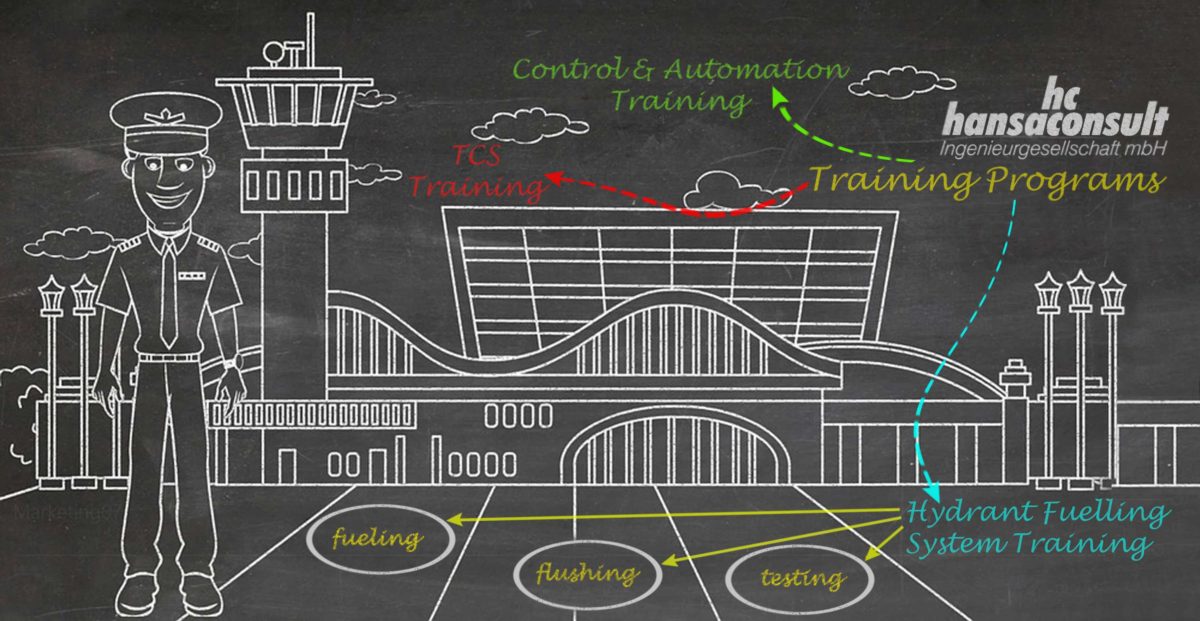
Preliminary training will be conducted during the commissioning on the Control System and later on during normal operations. A dedicated training to the operating personnel is foreseen additionally to the preliminary training. The fuel simulator KLEOPATRA as described above will also be utilized for training purposes.

The final configuration and the overall concept including the equipment and the scope of the system determine the investment. The local cooperation approach with knowledgeable partners is preferred by many of our clients to retain the full cost control and to simplify contractual matters, warranty /liability issues etc.
As world wide leader in the tightness control discipline and excellent reputation in engineering, documentation, programming and integration of automation systems for aviation fuelling facilities, we would suggest following items to be provided by hansaconsult.